Taking Temperature, Pulse, and Respiration: Step-by-Step Guide
Last Updated July 31, 2025, 9:15 a.m.
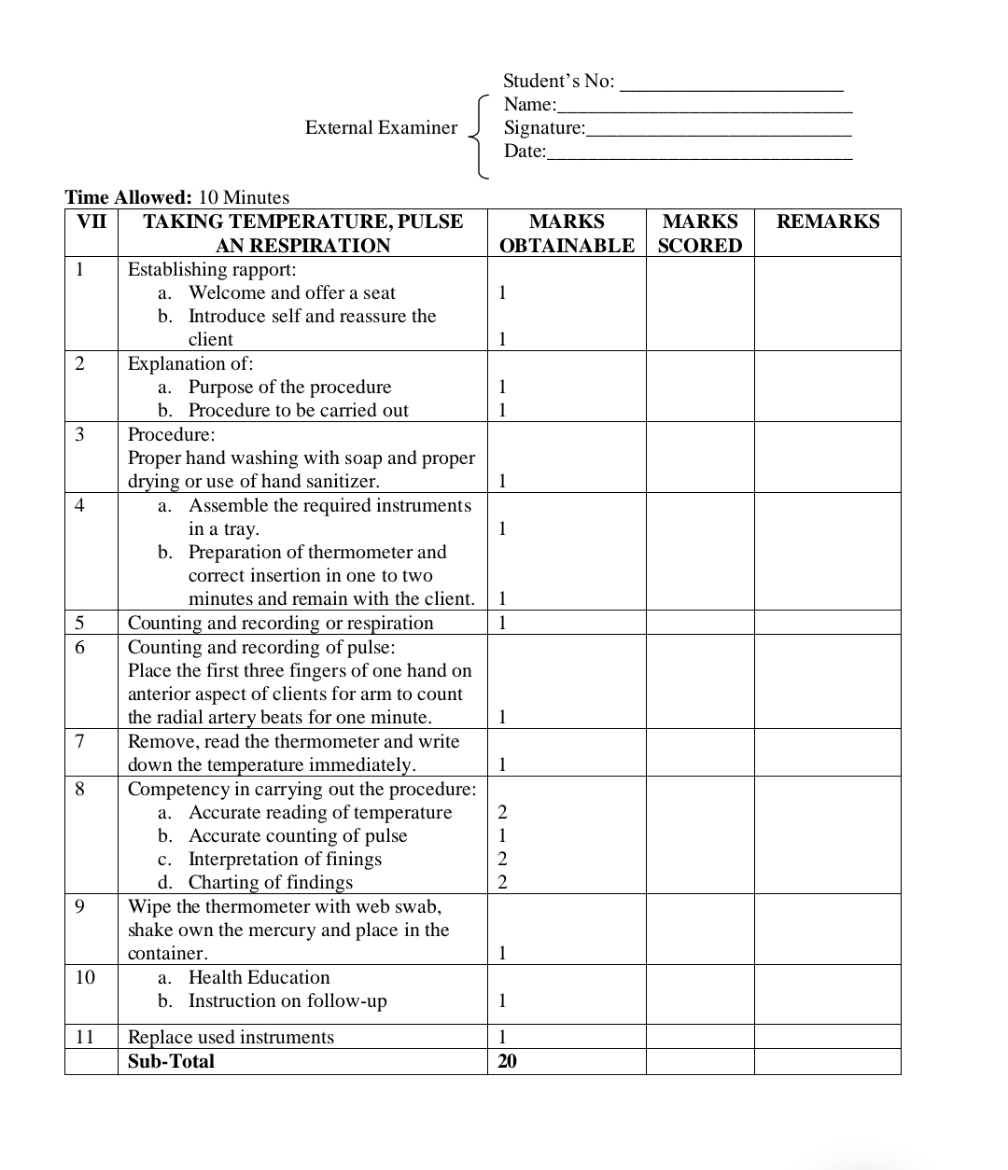
How to Take Temperature, Pulse, and Respiration: A Guide for Practical Examination
This guide provides a clear and accurate step-by-step procedure for Practical Examination to follow when performing basic patient assessments. Each step is important for ensuring proper care and accurate data collection.
1. Explanation of Purpose and Procedure (2 marks)
Start by greeting the patient politely. Explain your actions using simple language such as: “The assessment of your body functions will include checking your temperature and pulse as well as your breathing rate.” This helps build trust and calms the patient.
2. Hand Washing with Soap, Water, and Proper Hand Drying (1 mark)
Wash your hands thoroughly with soap and clean water for at least 20 seconds. Scrub all areas including palms, back of hands, between fingers, and nails. Rinse and dry with a clean towel or allow hands to air dry. This reduces the spread of infection.
3. Assemble the Required Instruments (2 marks)
Collect the following items:
- Thermometer (digital or mercury)
- Stopwatch or watch with second hand
- Antiseptic cotton swab or gauze
- Recording sheet and pen
4. Preparation of Thermometer and Correct Insertion (2 marks)
Shake a mercury thermometer to below 35°C. Insert appropriately:
- Oral: Under the tongue.
- Axillary: Place in the armpit and close the arm tightly.
5. Counting and Recording of Respiration (2 marks)
Without informing the patient, observe chest movements for one full minute. Count the number of breaths and record it. Normal adult range: 12–20 breaths per minute.
6. Counting and Recording of Pulse (2 marks)
Use your index and middle finger to feel the radial pulse on the wrist. Count for 60 seconds or 30 seconds and multiply by 2. Record rate, rhythm, and strength. Normal adult pulse: 60–100 beats per minute.
7. Remove and Clean Thermometer with Wet Swab (2 marks)
Clean the thermometer using a cotton swab or gauze soaked in antiseptic or 70% alcohol. Wipe from the bulb (tip) to the stem to avoid cross-contamination.
8. Reading and Recording of Temperature (3 marks)
Hold the thermometer at eye level and rotate it to see the mercury line. Read and record the temperature accurately. Normal oral temperature: 36.5°C to 37.5°C.
9. Clean and Shake Down Thermometer and Replace It in Container (2 marks)
After use, clean the thermometer again if needed. Shake it down below 35°C and return it to its container.
10. Interpretation and Follow-Up Instruction (2 marks)
Check the readings for abnormalities. Report any abnormal temperature, pulse, or respiration rate to a supervising nurse or health professional. Inform the patient of the next steps, for example: “Your temperature is a bit high. We’ll let the nurse know so she can assess you further.”
Total: 20 Marks
A well-conducted test reflects professionalism and improves patient care.
Community Health our concern